Memorising the Presidents in Order
Forty-seven presidencies, forty-five people, and a picture for every number, so 'who was the 19th?' comes as fast as 'who was the first?'. With a seven-day plan and a free drill.
The method is a fixed picture for every number from 1 to 47, the Major System peg for that number, with a sound-alike picture of the president hung on it: 19 is tape, so Rutherford Hayes is measuring a hay bale with a tape measure. The list becomes addressable rather than merely recitable, and that is a testable promise. By the end of "the first ten in pictures" you will hold a fifth of the list, in order, numbers attached, and answer "who was the seventh president?" without counting on your fingers. A week of twenty-minute sessions after that, you will have all forty-seven, forwards, backwards and by random number.
The list is a good test of a technique: long enough to defeat rote, it has to be in order, and it is full of traps, two Adamses, two Harrisons, two Johnsons, two Roosevelts, two Bushes, and two men who each count twice. This guide gives you the acrostic and the chain, says where each runs out, and then builds the pegs with the techniques this site teaches.
The list: forty-seven presidencies, forty-five people
Pages that say forty-four or forty-six were right when they were written. As of 2026 there have been forty-seven presidencies held by forty-five people. Numbers go to uninterrupted periods in office, not to people. Grover Cleveland served 1885 to 1889, lost to Benjamin Harrison, and won again in 1892, so he is the 22nd president and also the 24th. Donald Trump served 2017 to 2021, lost to Joe Biden, and returned in 2025, so he is the 45th and the 47th. Two more traps: William Henry Harrison and James Garfield each died within their first year, so two presidents took office in each of 1841 and 1881, and a vice-president who takes over mid-term gets the next number while a president re-elected to a consecutive term keeps his.
Here is the whole list with the year each term began. The last column is the sound-alike name picture you will build below; skip it on a first read. The pegs are listed by day in the plan.
| # | President | Took office | Name picture |
|---|---|---|---|
| 1 | George Washington | 1789 | washing machine |
| 2 | John Adams | 1797 | Adam's apple |
| 3 | Thomas Jefferson | 1801 | chef |
| 4 | James Madison | 1809 | mad son |
| 5 | James Monroe | 1817 | man rowing |
| 6 | John Quincy Adams | 1825 | queue of apples |
| 7 | Andrew Jackson | 1829 | car jack |
| 8 | Martin Van Buren | 1837 | burning van |
| 9 | William Henry Harrison | 1841 | hairy son |
| 10 | John Tyler | 1841 | tiler |
| 11 | James K. Polk | 1845 | polka dots |
| 12 | Zachary Taylor | 1849 | tailor |
| 13 | Millard Fillmore | 1850 | petrol pump (fill more) |
| 14 | Franklin Pierce | 1853 | pierced ear |
| 15 | James Buchanan | 1857 | book fired from a cannon |
| 16 | Abraham Lincoln | 1861 | chain link |
| 17 | Andrew Johnson | 1865 | toilet on an anchor |
| 18 | Ulysses S. Grant | 1869 | granite block |
| 19 | Rutherford B. Hayes | 1877 | hay bale |
| 20 | James A. Garfield | 1881 | orange cartoon cat |
| 21 | Chester A. Arthur | 1881 | sword in a stone |
| 22 | Grover Cleveland | 1885 | meat cleaver |
| 23 | Benjamin Harrison | 1889 | hairy Big Ben |
| 24 | Grover Cleveland | 1893 | meat cleaver (second) |
| 25 | William McKinley | 1897 | burger in a crown |
| 26 | Theodore Roosevelt | 1901 | teddy bear with a rose |
| 27 | William Howard Taft | 1909 | taffy |
| 28 | Woodrow Wilson | 1913 | volleyball with a face |
| 29 | Warren G. Harding | 1921 | hardening cement |
| 30 | Calvin Coolidge | 1923 | icy ledge |
| 31 | Herbert Hoover | 1929 | vacuum cleaner |
| 32 | Franklin D. Roosevelt | 1933 | frankfurter with a rose |
| 33 | Harry S. Truman | 1945 | man holding a TRUE sign |
| 34 | Dwight D. Eisenhower | 1953 | ice shower |
| 35 | John F. Kennedy | 1961 | can of candy |
| 36 | Lyndon B. Johnson | 1963 | lion on a toilet |
| 37 | Richard Nixon | 1969 | face of shaving nicks |
| 38 | Gerald Ford | 1974 | river ford |
| 39 | Jimmy Carter | 1977 | peanut cart |
| 40 | Ronald Reagan | 1981 | ray gun |
| 41 | George H. W. Bush | 1989 | bush clipped into an H |
| 42 | Bill Clinton | 1993 | tin being cleaned |
| 43 | George W. Bush | 2001 | bush clipped into a W |
| 44 | Barack Obama | 2009 | bomber jacket with an O |
| 45 | Donald Trump | 2017 | trumpet |
| 46 | Joe Biden | 2021 | auction paddle (bidding) |
| 47 | Donald Trump | 2025 | trumpet (second) |
The first ten in pictures
Here is a fifth of the job, done with the site's own scenes. Each number's fixed picture is its Major System peg, a word spelled from the number's consonant sounds; the rule comes later. Each scene puts the president inside the peg's picture, with the name picture added as a handle for a face you would not recognise. Read each slowly enough to see it, then close your eyes and replay it. Ten minutes.
1, tea. Washington in a wooden boat on the Potomac, pouring a single cup of tea over the side: the inaugural toast. The washing machine is in the boat with him, churning.
2, Noah. John Adams as a stout Noah at the gangway of an ark, counting founding fathers aboard two by two. His Adam's apple bobs as he counts.
3, Ma. Jefferson at Monticello with three quills while his mother hands him a draft of the Declaration. A chef's hat sits on the desk.
4, ray. Madison, who was small, under a single beam of light at a tiny desk drafting the Bill of Rights. A mad son stamps his feet just outside the ray.
5, law. Monroe in a powdered wig brings a gavel down: the law of this hemisphere. Behind him a man rows a boat across the courtroom floor.
6, shoe. John Quincy Adams, after his presidency, one shoe wedged in the floorboards of the House, still arguing against slavery. A queue of apples waits behind the shoe.
7, key. Jackson at the door of the Bank, a brass key shaped like a 7 in his hand, locking it for good. A car jack props the door while he turns the key.
8, ivy. Van Buren's enormous sideburns curl into ivy across his cheeks. The ivy is on fire: it is a burning van, and the van is his face.
9, pie. William Henry Harrison in the cold rain holding a pie cut into nine slices with one missing, because he was gone a month into the term. A small hairy boy holds the missing slice.
10, toes. Tyler at the Texas annexation table, counting the ten toes of a new Texan baby with a tiler's trowel.
Now cover the page. What was the seventh? Seven is a key; who is turning it? The ninth? A pie; who stands in the rain with it? Go backwards from ten to one, then pick numbers at random. If a scene does not come, it was not built; go back and make the two objects touch.
Why the middle is the hard part
Write the list from memory before starting and the result has a predictable shape. Henry Roediger and Robert Crowder asked students to do exactly that in the 1970s and found a textbook serial-position curve: the first few presidents and the most recent come back, the middle collapses, and Lincoln alone stands out from his neighbours, which they put down to distinctiveness. Roediger, later with K. Andrew DeSoto, followed the question for forty years, and every cohort was in the process of forgetting the eight or nine presidents before the one in office; fewer than a quarter could put more than the first five in order. So the presidents you will forget are not random: the ones between Van Buren and McKinley, minus Lincoln, and, as the decades pass, the ones between Truman and Carter. The plan below gives both stretches extra time.
The acrostic sentence
The schoolroom trick for the list is a sentence whose initials spell the presidents. The long version that circulates online runs from Washington to Obama, and has not been extended since:
When A Joke Made Me A Joker, Van Held The Poker, The Fiery Poker, But Long John Grant Had Gone And Chased His Crazy Mooses 'Round The West Hollering, "Can't Help Rinse Those Empty Kettles Just Now, Friend." Come 'Round By Charlie's Bed Often.
Its first ten words, "When A Joke Made Me A Joker, Van Held The", are the "first ten presidents" sentence people search for: Washington to Tyler, a rhythm, the initials in order. A shorter one covers the first eight: "Will A Jolly Man Make A Jolly Visitor?"
Two failure modes. An initial is not a name: "A" gives you Adams but not which Adams, "H" is two Harrisons, Hayes, Harding and Hoover. The sentence orders letters and leaves you to supply the names from somewhere else, which for the middle of the list is exactly what you cannot do. And an acrostic has no addresses: ask "who was the nineteenth?" and you are counting words from "When".
A link story for the names
The technique that works for names is the link method: turn each name into a picture you can see, then make each picture do something to the next, so the chain pulls itself along. Names are sounds, so the pictures come from sound: Washington is a washing machine, Adams an Adam's apple, Jefferson a chef. Lorayne and Lucas call this the substitute word. The pictures in the table are one set; change any that do not land. The one rule is disambiguation: each doubled surname gets two different pictures, and Tyler is a tiler while Taylor is a tailor.
Then chain them. Here is Polk to Garfield, the deepest part of the trough: a coat covered in polka dots is being taken in by a tailor, who runs out of thread and drives to a petrol pump to fill more; the nozzle pierces his ear; from the wound falls a book, which is loaded into a cannon and fired; it flies through a giant chain link; the link is the flush chain of a toilet hanging from a ship's anchor; the anchor rests on a block of granite; the granite is stacked on a hay bale; and asleep on the bale is a fat orange cat. Polk, Taylor, Fillmore, Pierce, Buchanan, Lincoln, Johnson, Grant, Hayes, Garfield: 11 to 20.
It is not the best tool for the numbers. In 1980 Roediger tested 150 undergraduates on twenty-word lists with the link method, a peg list, the method of loci, plain imagery and no instruction. On the immediate test everyone given a mnemonic beat the controls, but scored by exact position, pegs and loci came out best, the link method was intermediate, and plain imagery was no better than nothing. A chain tells you what comes after Hayes. It does not tell you that Hayes is nineteenth; for that you walk the chain from the washing machine and count.
A Major peg for every number
The fix is to give every number its own permanent picture and hang the president on it. That is the peg system, and the peg list this site uses is the Major System, where each digit is a consonant sound (1 is t or d, 2 is n, 3 is m, 4 is r, 5 is l, 6 is sh or ch, 7 is k, 8 is f or v, 9 is p or b, 0 is s or z) and each number from 00 to 99 is a word made of those sounds: 1 is tea, 16 is dish, 19 is tape, 22 is nun, 40 is rose. Every president entry on this site is a scene of the president with the Major peg for that number. The sixteenth is served on a dish.
The nineteenth is measured with a tape.
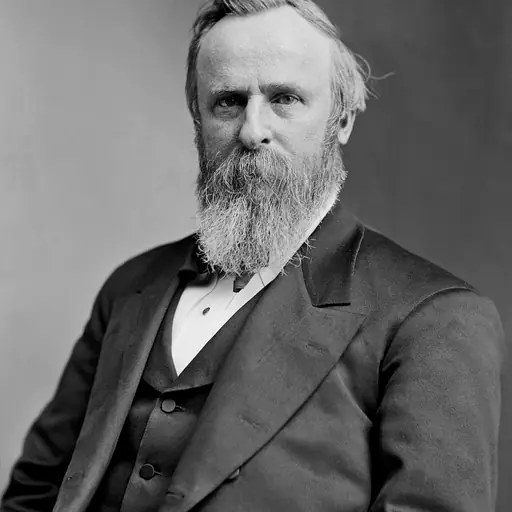
Now "who was the nineteenth?" is not a walk. You hear nineteen, the sounds are t and p, the peg is tape, and there is Hayes with a tape measure across a pile of disputed ballots. The reverse works too: someone says Hayes, you see the tape, you read t-p off it, nineteen. That reversibility is why Major pegs, not rhyming pegs (one-bun, two-shoe) or arbitrary pictures, are the tool for a list of forty-seven: a rhyming list stops at ten and an arbitrary picture cannot be decoded.
One caveat from the peg guide needs squaring with this: for anything you want to keep for months, it says, use a palace. That warning is about reusing one peg list for many lists, where the old contents interfere: the peg for 19 cannot hold this week's shopping and Hayes at once. A single permanent list that owns its pegs is the exception, and this is one: each president is the permanent tenant of his number, and the list stays on the pegs for years. If you also use the pegs for other lists, and once you know them you will, give the presidents a route as well: the palace below.
The Cleveland problem and the Trump problem
Two men appear twice, and this is where every method other than pegs quietly breaks. A song sings Cleveland twice and you cannot tell which verse you are in; a chain that runs "cleaver, Big Ben, cleaver" is a loop; a note-to-self ("Cleveland is also 24") fails on exam day. Songs suit a child, and newer ones go past the 1995 Animaniacs song, which stops at Clinton (Numberock's reaches the 47th), but none gives an address: "who was the nineteenth?" means singing from the top.
With pegs the repeat costs nothing, because you are remembering a scene at a number, not a person at a position, and the two scenes are different. Cleveland at 22 is a nun (n, n): the site's picture has two nuns crossing a Buffalo park, one of them the rumoured mother of his child. Cleveland at 24 is Nero (n, r), fiddling on the White House lawn while a banking panic burns.
Trump is the same, with one wrinkle: the site's president set covers 1 to 46, Washington to Biden, and its entries 47 to 50 are bonus figures, not presidents. So number 47 (2025) is your first addition, with the peg taken from the Major chart: 47 is a rock (r, k). Make it a trumpet blown so hard it cracks a rock, nothing like the 45 scene, which on this site is a gilded balcony rail. No loop. The same rule keeps the list current, which the songs and the acrostic (it stops at Obama) cannot: the next president takes 48, r-f, a roof, and the scene is whatever the surname sounds like, on a roof.
A palace, one room per era
There is a reason to add a route even if pegs come easily: the memory palace, the scenes placed at fixed spots along a walk through a building you know. Roediger's 1980 results put loci and pegs level for positional recall, so the route adds no power. What it adds is a second address that nothing else on the Major pegs can overwrite, and the eras, which come for free. Use five rooms of about ten spots:
| Room | Numbers | Years | Era |
|---|---|---|---|
| 1 | 1 to 10 | 1789 to 1845 | founders and the early republic |
| 2 | 11 to 20 | 1845 to 1881 | Civil War and Reconstruction |
| 3 | 21 to 30 | 1881 to 1929 | Gilded Age and Progressives |
| 4 | 31 to 40 | 1929 to 1989 | Depression, war, Cold War |
| 5 | 41 to 47 | 1989 to present | the present era |
"Which era was Arthur?" is then answered by where you are standing; the peg in the scene gives the exact number. Walk the ten scenes above through a building you already own, or adopt one of the stock palaces on this site and fill its rooms with them.
Adding the years
Once the names and numbers are solid, and not before, add the year the term began (the third column of the table above) to the scene you already have. The peg is the address and everything else is furniture: add furniture freely, but never replace the peg. The same pegs serve for the year. The century is obvious from the neighbourhood, so encode the last two digits: Hayes began in 1877, 77 is k-k, a cake, so the tape is stretched across a cake as well as the ballots. Do this only for the presidents an exam will ask; with the order and a few anchor dates (1789, 1861, 1901, 1933, 1961) the rest can be reckoned to within a term or two.
A seven-day plan
Ten scenes a day, and every session begins with a test of what you did before. That order matters: Roediger and Jeffrey Karpicke showed that re-reading beats self-testing five minutes later and loses to it by a wide margin at two days and a week, while feeling better, which is the trap. Why the later reviews are spread out is the subject of the spaced repetition guide. Budget two to three hours across the week, and a second week if you want the dates.
Day one. The first ten, from the pictures above. Test forwards, backwards and by random number before you stop.
Day two. Recall 1 to 10 cold, then build 11 to 20: tot, tin, tomb, tire, towel, dish, tack, dove, tape, nose. This is the trough, so give the scenes more detail than feels necessary. Test 1 to 20.
Day three. Recall 1 to 20, then 21 to 30: knot, nun, name, Nero, nail, notch, neck, knife, knob, mouse, with both Clevelands as separate scenes. Test 1 to 30.
Day four. Recall 1 to 30, then 31 to 40: mat, moon, mummy, mower, mule, match, mug, movie, map, rose. This is the second trough, Truman to Carter, and gets the same extra detail as 11 to 20. Test 1 to 40.
Day five. Recall 1 to 40, then 41 to 47: rat, rain, ram, rower, rail, rash, and your own rock for the second Trump. Run the whole list once forwards.
Day six. No new material. Test all forty-seven three ways: forwards, backwards from 47, and twenty random numbers. Every miss is a weak scene; rebuild it with a stronger interaction and test it again an hour later.
Day seven. One full run, then stop, and space the reviews from here: about one, six and sixteen days later, then monthly, and once more before whatever you need it for. For a child, make it ten scenes a week, drawn rather than imagined, and test out of order from the first day.
Drilling it
Which leaves the promise. Cover the table and write the list from 47 down to 1, numbers and names, then pick three numbers at random: if they come as pictures rather than counting, you have the list.
To drill it, open the practice page and choose the presidents mode (number to name, 1 to 46). If the mode is disabled or the deck is empty, adopt the set at the onboarding page (headed "US Presidents 1–50"; the last four are the bonus figures), which adds the forty-six scenes, Washington to Biden, to a personal deck. The mode runs on the custom drill: you pick a card count (5, 10 or 20) and a memorise time of 15 seconds to three minutes; the runner shows each card, number and name together, then the recall phase shows "19th president", you say the name, reveal it, and grade yourself miss, hard or easy. Cards are ordered by SM-2 priority and never shuffled: the ones that are due come first, then the ones you have not drilled, then the rest, each group in deck order, and a missed card returns the next day. So the random-number test is yours to run: have someone read numbers, or surnames for the reverse direction, while you answer.
The canonical Presidents ships with Major Dictionary as a starter system you can edit, override, and drill against. One click to adopt; the system joins your dictionary and the practice surfaces light up.